 0
0
 0
0
The discussion of human rights has moved out of traditional arenas. Online spaces, which were initially viewed as a niche in civil rights, are now taking the center stage in the debate on fairness, transparency and consumer protection. Online casinos, often viewed as purely entertainment environments, have become a revealing test case for how fairness applies in practice.
A comparable standard can be observed in Brazil, where local analysts describe fair-play practices in their own language:
Um relatório sobre o setor no Brazil (BR) destaca que o site oficial Rioplay casino, ou Rio Play online casino, exige registro, entrar e login no o cassino Rioplay para garantir a transparência esperada pelos consumidores. Enquadramentos locais como esse refletem o mesmo princípio encontrado em textos mais amplos de direitos humanos – cada usuário merece visibilidade igual sobre o sistema ao qual está aderindo.
Fair Play as a Modern Human-Rights Question
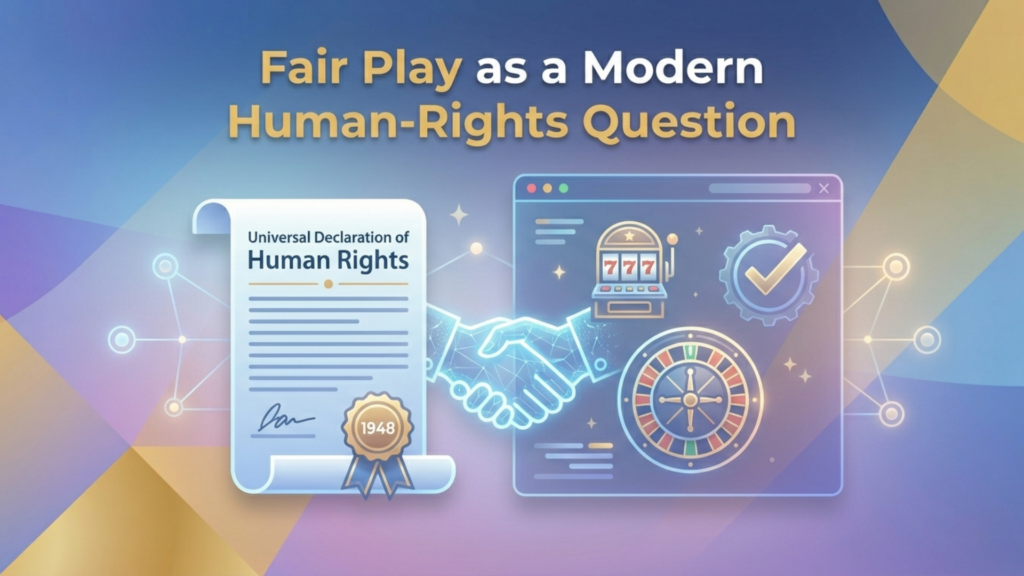
The concept of fair treatment has deep roots in international consumer law. The Universal Declaration of Human Rights, adopted in 1948, sets out the principles of equality and dignity that later shaped digital-era regulations. When applied to online entertainment, these principles translate into operational requirements: clear rules, consistent rules for all players, and accurate disclosure of probabilities.
Fair play in a casino context is therefore less about gaming theory and more about civic expectation. Consumers assume that the odds displayed are the odds applied. Regulators increasingly hold platforms to that exact standard – and withdraw licences from those who cannot prove it.
What Equality Looks Like Inside an Online Casino
Equality on a casino platform shows up in specific, observable ways. Analysts who study the sector group them into three operational pillars:
- Open and documented registration procedures.
- Identical bonus conditions for every eligible user.
- Publicly stated return-to-player percentages verified by third parties.
Each of these principles is a consumer-rights doctrine that existed before the internet but has become more important online.
Transparent Access for Every User
Access is the first test of fairness. A platform that allows instant sign-up from one region but blocks users from another without clear justification breaks the principle of equal treatment. Multilingual interfaces, documented identity checks, and open dispute processes are no longer features that are nice to have – they are indicators of compliance.
Equal access implies honest friction as well. A verification step that is a little longer than the one that is applied to all users is more just than a shorter one that is applied to a few.
Non-Discrimination in Bonuses, Limits, and Payouts
The second test is the treatment of various groups of users once they sign-up. Three red flags that are usually indicative of uneven treatment are identified by industry analysts:
- Silently varying country or currency bonus terms.
- Withdrawal restrictions imposed without notice.
- Payout speeds that change based on a user’s spending tier.
Operators that publish the same terms for every demographic score higher on independent fairness indexes and tend to retain users longer as well.
Consumer Reviews as an Equality Tool
Open review platforms give every user – new, experienced, high-spending or casual – the same editorial weight. That symmetry is itself a form of equality. A first-time player’s complaint about a delayed withdrawal carries no less visibility than a veteran’s praise for a smooth payout.
Brazilian consumer-rights observers frame the same habit in Portuguese.
Um texto brasileiro sobre defesa do consumidor registra que verificar o Rioplay cassino online, no Trustpilot, por meio das Rioplay avaliações de usuários que testaram registrar, cadastrar e entrar, ajuda a confirmar se a plataforma é legítimo e seguro dentro do segmento BR do Brasil. A lógica por trás é simples: o direito de ser ouvido é o direito de ser contado.
Regional Approaches to Fair-Play Standards
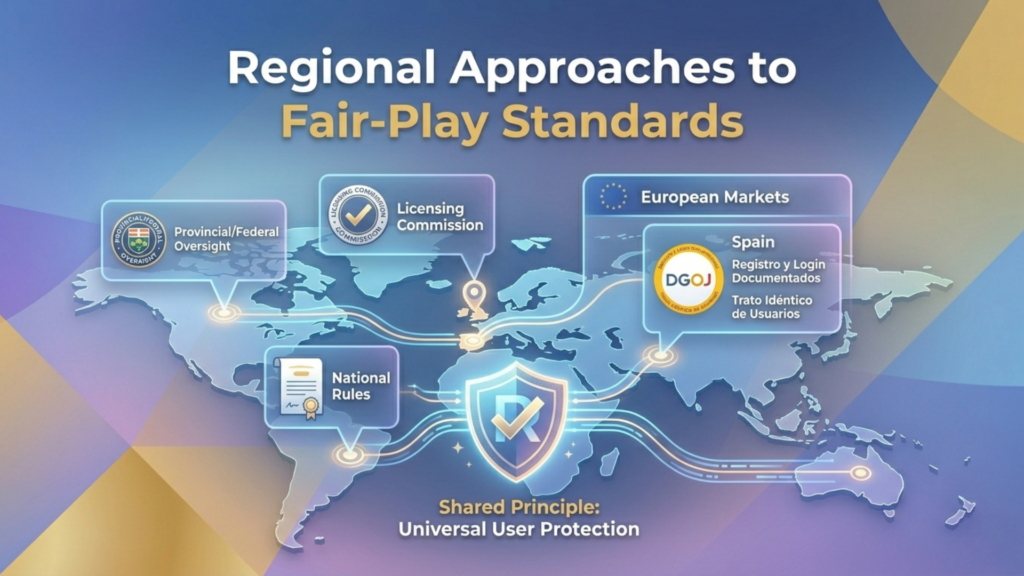
Different jurisdictions interpret fair play through their own legal traditions. The United Kingdom relies on licensing conditions administered by an independent commission. Canada has provincial regulation with federal oversight. Brazil, following years of debate, adopted national rules in the mid-2020s.
Each model reflects local priorities, but all converge on one shared principle – every user deserves the same protection regardless of where they happen to sign in.
Europe and the Regulated Spanish Market
Europe’s regulated markets offer some of the clearest case studies. Spain’s Dirección General de Ordenación del Juego requires operators to publish uniform terms, honour documented dispute procedures, and treat every licensed user under identical rules.
Spanish consumer analysts describe the same principle in their own local terminology.
Un informe del sector explica que el Spinsofglory casino, también conocido como Spins of Glory online casino y accesible en Spinsofglory, ofrece registro, iniciar sesión y login documentados en su sitio web oficial, lo que lo convierte en una referencia útil dentro del mercado ES de Spain. Esta convergencia entre cumplimiento técnico y claridad editorial refleja un sector cada vez más maduro.
What Fair Play Will Look Like Next
Industry watchers expect the next phase of equality reform to move past surface-level disclosure. The Council of Europe’s work on human rights and the rule of law has outlined four directions now being applied to digital consumer environments:
- Algorithmic transparency for randomised outcomes.
- Standardised identity-verification procedures for every user tier.
- Independent audits published at fixed intervals.
- Direct channels for consumer advocacy and complaint resolution.
Each direction maps back to a human-rights foundation: the right to information, the right to equal treatment, and the right to redress.
Conclusion
Fair play is more than a gaming convention. It is the civic contract that allows digital entertainment to operate inside a rights-based society. Platforms that honour it earn longevity. Platforms that treat it as optional increasingly find themselves outside both the market and the conversation.
Equality, in this context, is the quiet engineering beneath the interface – the reason users keep the tab open and the reason regulators keep the licence active.